Back
Back 

Content of the article:
- What depends on the choice of tourist dishes
- Ultralight: minimum weight — maximum efficiency
- Trekking and hiking: balance of weight and convenience
- Road trips and camping: comfort comes first
- Materials of tourist dishes: what to choose
- Practical advice
- Conclusion: how to choose tourist dishes without mistakes
Tourists joke that hiking is to get away from civilization and eat everything you brought with you. But the fact is simple: on any trip, you will have to cook or heat food, so tourist dishes are a basic element of equipment.
It is often underestimated: as a result, either excess weight or insufficient recruitment. This is especially noticeable when one set is used both as a camping dish and as a camping dish, although the requirements are different.
Tourist dishes should be selected according to the format of the trip: somewhere critical weight, and somewhere comfort. There is no universal solution. In this article, we will discuss how to choose travel utensils for different scenarios, from trekking to camping and road trips.
What depends on the choice of tourist dishes
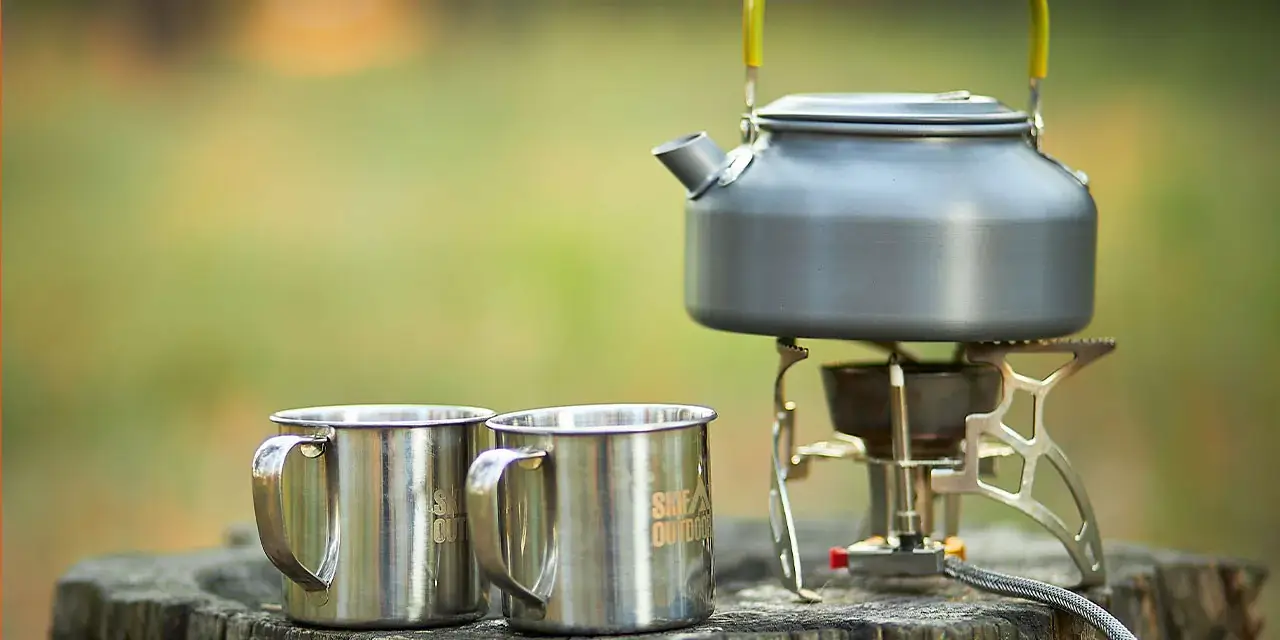
It is necessary to choose a portable kitchen based on the conditions in which it will be used. And how to choose tableware for a trip depends on several key factors that determine the composition and format of the set.
Main selection criteria
- Type of trip– kitchen utensils for hiking should be light and compact, and for camping convenient and functional;
- Duration of the trip- the longer the route, the more thoughtful the equipment for cooking should be - both in terms of volume and reliability.
- Number of people- a kit for a solo hike is significantly different from a kit for a group: both the volume and the format of the equipment change.
- The method of cooking on a trip- one type is required for a gas burner, another, with higher heat resistance, for an open fire.
- Equipment weight- this is critical when hiking, so hiking utensils should be as light and compact as possible.
- Comfort level- more "extra" is allowed in the campsite, so dishes for trekking and for a stationary camp can be very different.
Therefore, before deciding which dishes to take on a trip, it is worth clearly defining the scenario of use - this will allow you to assemble an effective set without excess weight.
Ultralight: minimum weight — maximum efficiency
The Fast & Light or ultralight approach involves reducing the weight of all equipment to the maximum. From food, preference is given to ready-made sublimated dishes or dried, so pots and mugs are selected accordingly. It is important that each element performs several functions or is critical.
What dishes are needed for ultralight
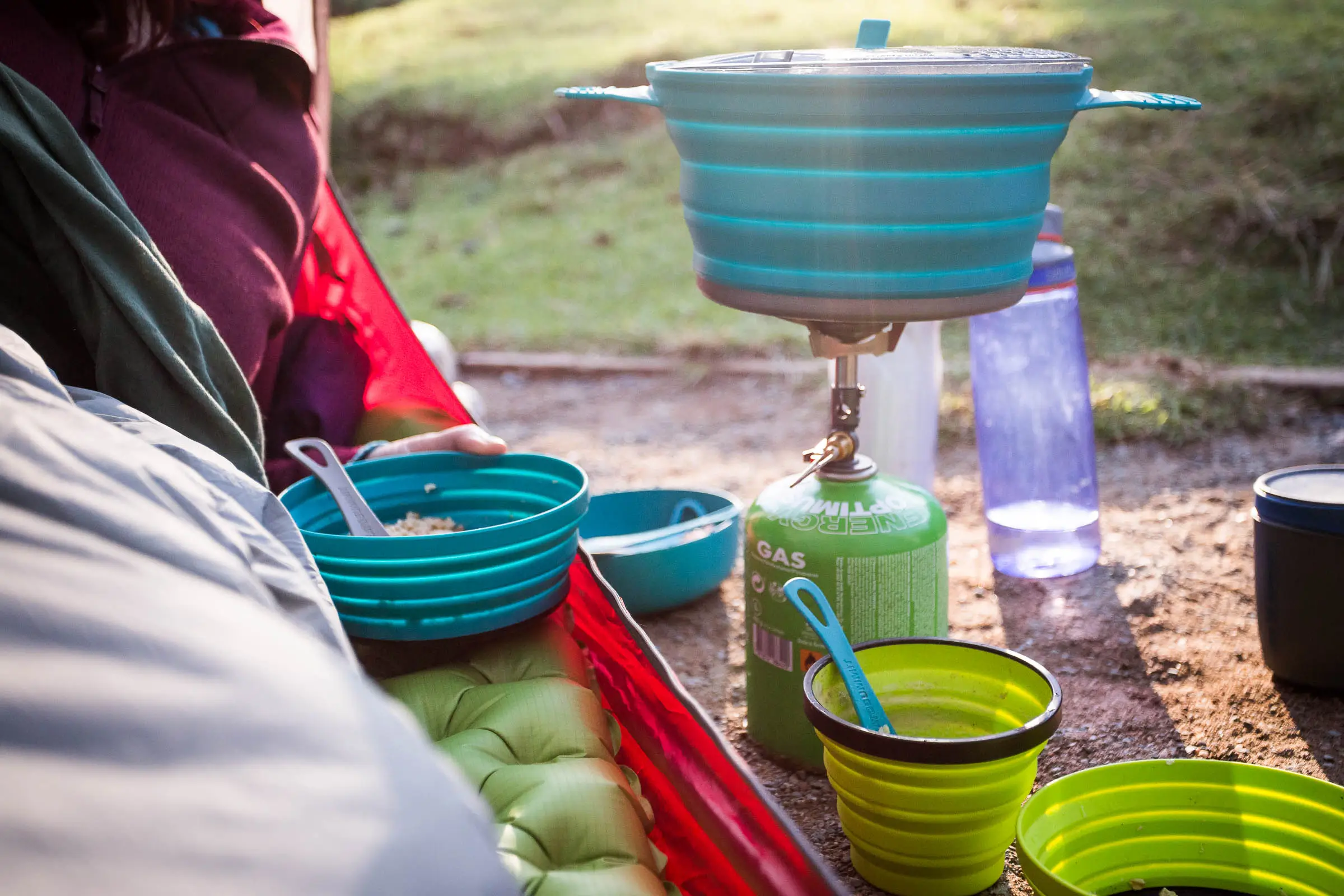
The main criteria are light weight, compactness, functionality. Silicone dishes and individual sets deserve special attention in this segment. They are light, thought out to the smallest detail in terms of compactness.
The set of dishes for ultralight hikes should include:
- light cauldronfor hiking or a universal metal tourist mug - to boil water, cook food, eat and drink tea from it;
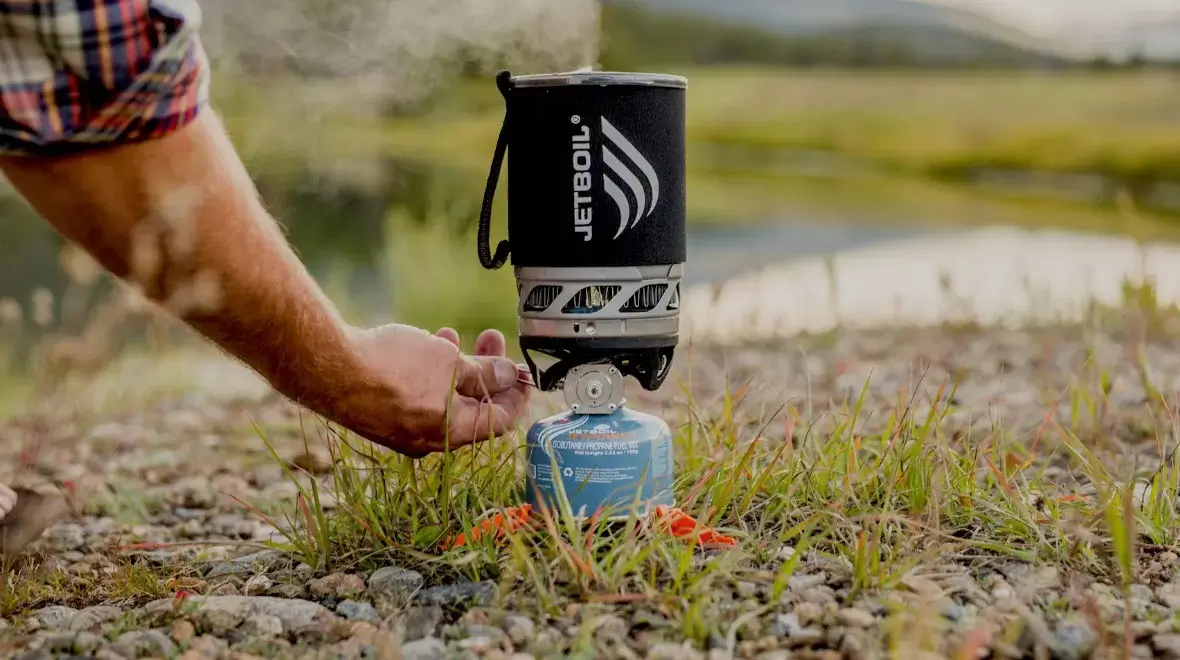
- burner orintegrated cooking system– the latter will be more universal, as it already includes a cauldron and a burner;
- cutlery- a spoon and fork, or a fishing rod. Usually made of plastic or titanium, have an elongated handle. Sophisticated cutlery is a real must-have for the modern tourist.
What materials to choose for dishes on a light hike
We choose from what is lightest in weight and functional. Therefore, here the choice falls on:
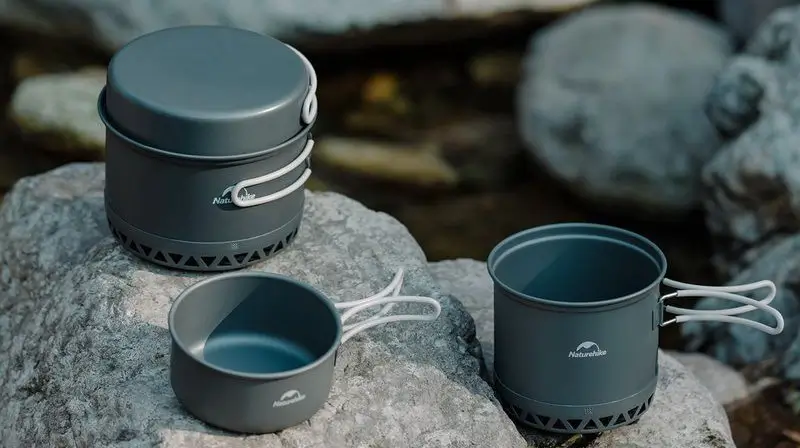
- titanium tableware for hiking- good thermal conductivity, low weight, from the minuses - high price;
- complex silicone– compact, light, practical, easy to wash. A special note is the silicone cookware with an aluminum bottom from Sea to Summit, which can be used with gas burners.
- thin-walled aluminum- light, conducts heat well, it is better to choose anodized, it will be more resistant to scratches. Aluminum travel cookware is more affordable than titanium.
Trekking and hiking: balance of weight and convenience
During long-term trekking, it quickly becomes boring to eat sublimated food, so full-fledged simple dishes are often prepared here - porridge, pasta with stew, traditional borscht, etc. Plus, in such trips, groups are much larger than 1-2 people, you have to cook for everyone at once. That is why it is worth distinguishing a group and an individual set.
The optimal set for trekking
Utensils for group hiking or trekkinglooks like this:
- tourist cauldron for 2-4 people, depending on the size of the group. It can be aluminum, titanium or even cast iron;
- a long spoon for mixing, a cutting board;
- water container per group - collapsible canisters, buckets, etc.
Individual set (KLMN)
- a folding or metal mug;
- a plastic or aluminum spoon;
- tourist bowl - food-grade silicone, metal, rarely plastic;
- knife, if desired.
If you plan to cook on a gas burner, it is important to take into account the size of the pan, because the burner and dishes should correspond not only to the number of people in the group, but also to match each other in size. If you are going to cook over an open fire, don't forget a tripod and kindling tools.
The main requirements are weight, since you will have to carry it on yourself, and compactness or the ability to conveniently fold it into a backpack and practicality.
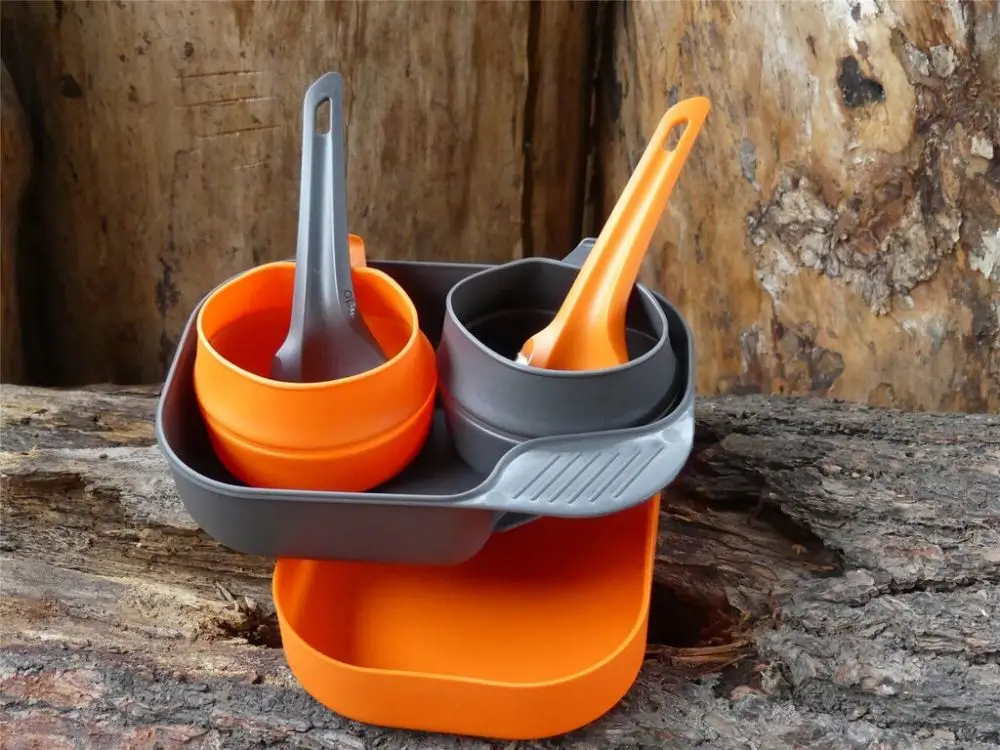
A tourist set of dishes for trekking is a compromise between minimal weight and functionality, where each element has to perform several tasks. It is optimal when the pan can serve as a bowl, the lid as a frying pan or a plate, and the whole system compactly consists of a "matryoshka doll" together with the burner andballoon.
Road trips and camping: comfort comes first
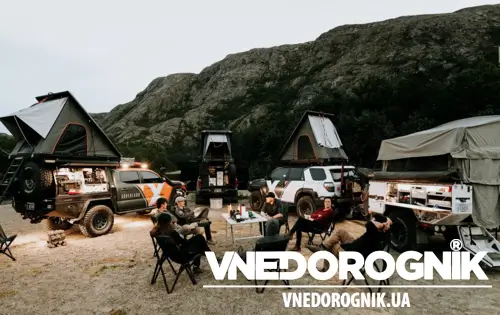
This format of rest makes it much easier to choose equipment. Camping utensils are no longer limited by weight, you can choose any pots and pans. This opens up the possibility to prepare a variety of dishes, not limited to simple solutions, as in trekking. You can take more voluminous and convenient tableware for road trips, which is suitable for a company or family vacation. The main thing is to focus on ease of use, durability and functionality, because transportation is usually done by car, not on your own shoulders.
What is included in the camping tableware set
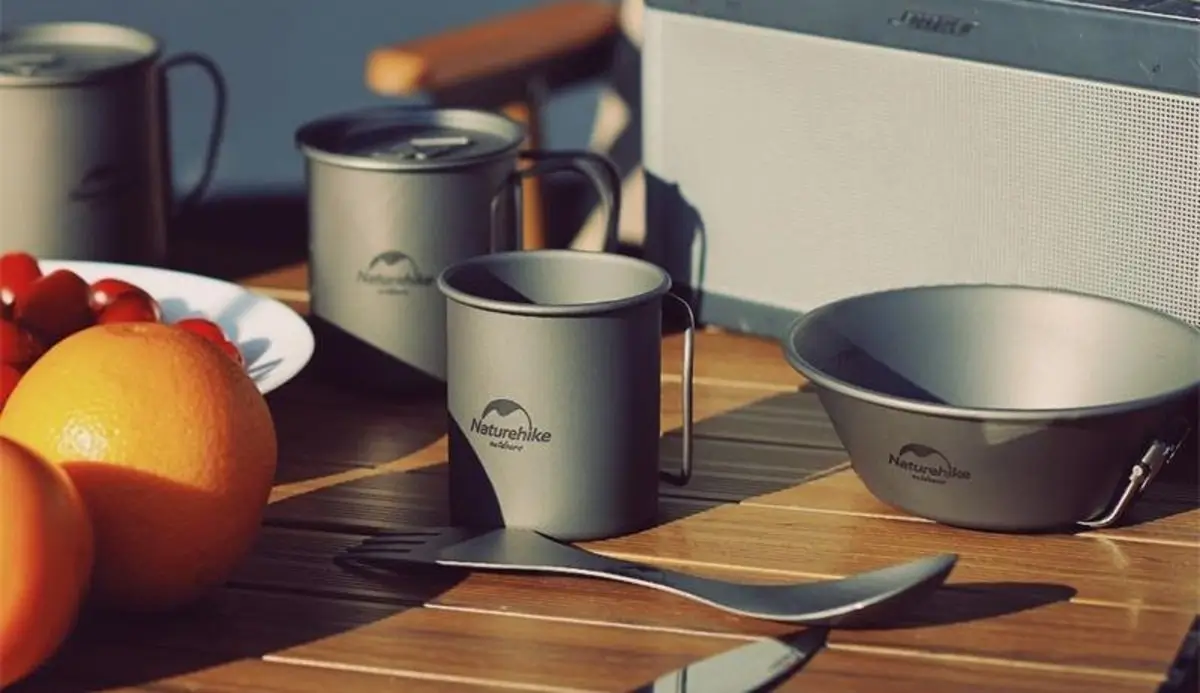
The general set of dishes for camping looks like this:
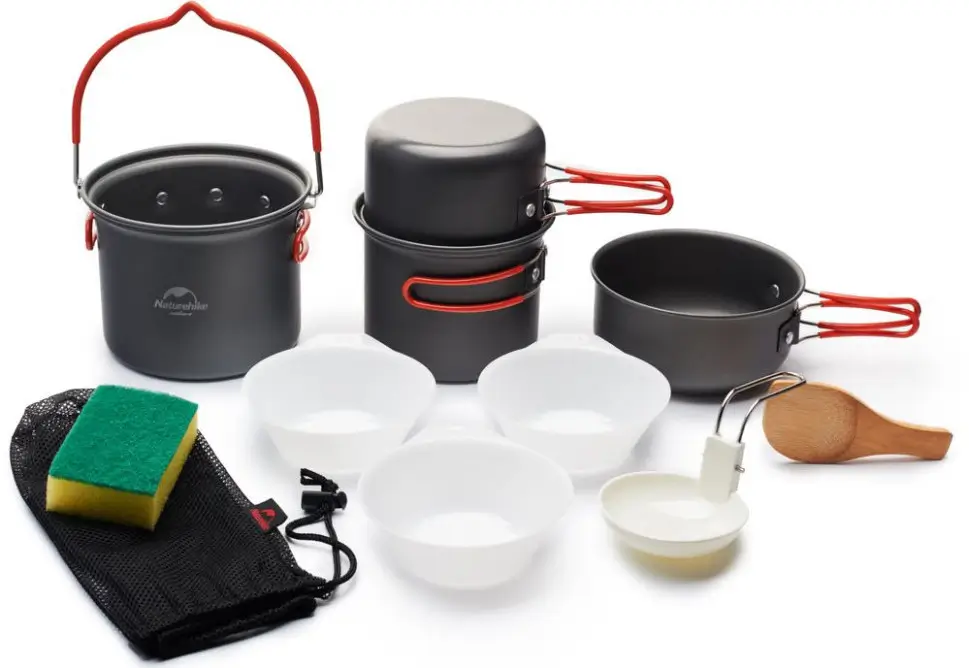
- Pots and cauldrons — for cooking main dishes; the volume is selected according to the number of people;
- Frying pan - convenient for breakfast, frying meat, vegetables or eggs;
- Teapot or coffee pot— for boiling water and making drinks;
- Plates / bowls - individually for each participant;
- Mugs — for hot and cold drinks;
- Cutlery — spoon, fork or a basic set of utensils;
- Kitchen utensils — spatula, ladle, cutting knife, cutting board;
- Containers for food — for storing and transporting food;
- Sponge and detergent — to maintain cleanliness even in field conditions;
- Cases or bags for convenient transportation and organization.
What is real to take, and what is superfluous
What to take (optimal minimum for camping):
- camping pot or kettle (1–2 pcs. per company);
- tourist frying pan (if you plan to fry something);
- a kettle or one pan for water;
- mug + bowl for everyone;
- basic utensils (spoon, knife);
- kitchen knife + cutting board;
- spatula or tongs;
- sponge and detergent.
What you can not take (or take as needed)
- a separate set of pans "for all occasions";
- a large number of dishes "in reserve";
- complex kitchen devices (graters, blenders, etc.);
- fragile dishes (glass, ceramics);
- many identical objects (3 knives, 2 teapots, etc.).
Practical advice:
it is better to take less, but universal. In camping, comfort is not created by the number of things, but by the thoughtfulness of the set. If in doubt, you probably don't need this thing.
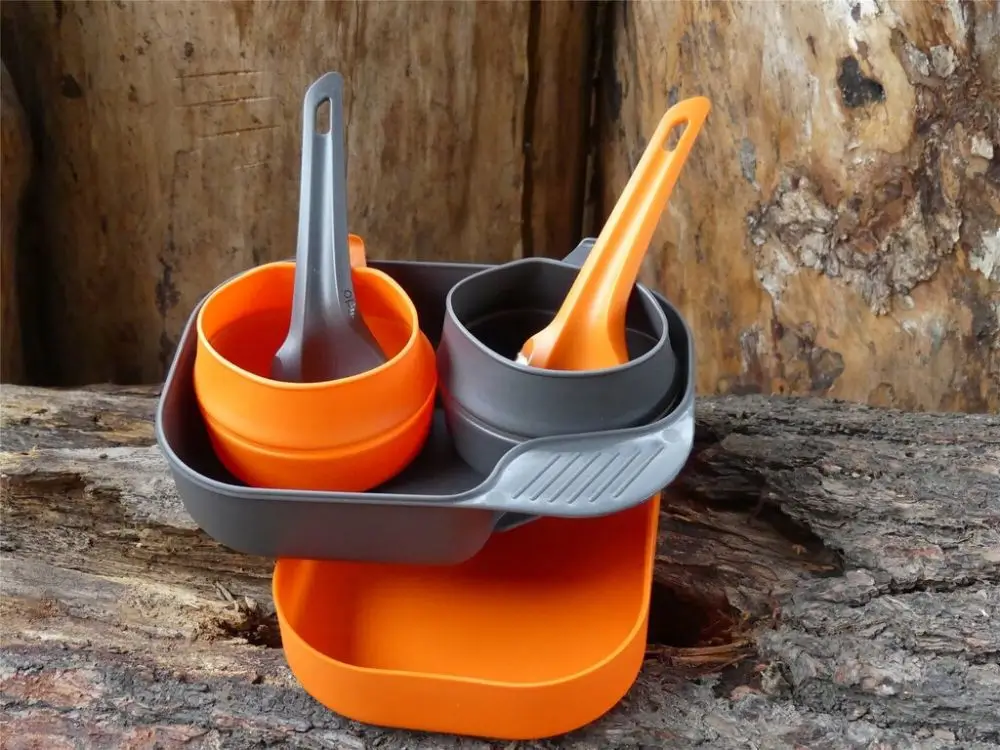
Camping tableware
Here, it is important to start from what dishes you will cook and on what. If you plan to cook on an open fire, pay attention to cast iron, stainless steel and aluminum. They will heat up evenly. If you cook forgas stovesandburners- then titanium and anodized aluminum, they heat up faster.
Materials of tourist dishes: what to choose
Each of the materials has its advantages and disadvantages, it is important to take into account the peculiarities of the trip, the format of the food. Next, we will consider the most popular materials:
- Aluminum— the basic option for most hikes and camping. Lightweight, heats up quickly and has an affordable price. Minus — it can be deformed and without coating sometimes affects the taste of food.
- Anodized aluminum— improved version: stronger, resistant to scratches and corrosion, does not react with products. One of the best options for the balance of price and quality.
- Stainless steel— durable and practically "unkillable". Good for an open fire, but it takes longer to heat up and is heavier, so it is more relevant for camping than trekking.
- Titanium— a choice for those who count every gram. Very light, strong and durable, does not affect the taste of food. The disadvantage is the high price and uneven distribution of heat, so your food may burn.
- Cast iron— ideal for car camping: excellent heat retention, suitable for frying and stewing. At the same time, it is heavy and requires care.
- Food grade silicone— used for bowls, mugs and collapsible tableware. Silicone mugs and bowls will be light and compact. And kettles and pans with an aluminum bottom can be used together with gas burners, the main thing is that the flame does not touch the side walls.
- Plastic- light, practical, not suitable for contact with open fire. But at the same time, devices made of plastic will be more practical.
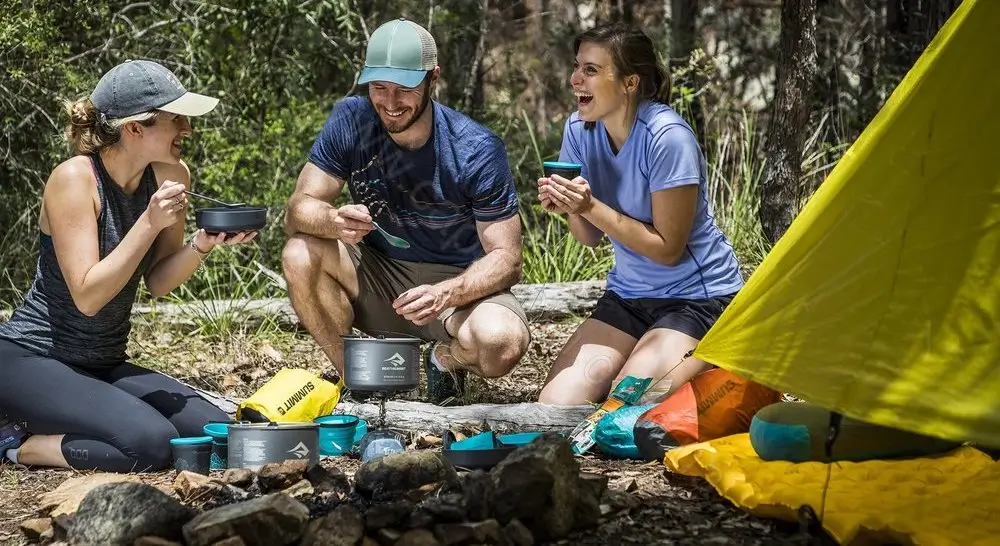
Comparative table of materials for tourist tableware
| Material | Weight | Strength | Price | Scenario | Pluses | Miuses |
| Aluminum | Light | average | low | Camping, trekking, road trips | Light, heats up quickly | It can be deformed, without a coating it can affect the taste of food |
| Anodized aluminum | Light | Above average | average | Camping, trekking, road trips | Stronger than ordinary aluminum, does not oxidize, durable | More expensive than ordinary aluminum |
| Steel | Medium/severe | High | average | Kemipng, an open fire | very strong, not afraid of fire | Heavier, heats up longer |
| Cast iron | Heavy | Very high | low | Car camping | Keeps warm well, ideal for frying | Very heavy, needs special care |
| Food grade silicone | Very light | Low/medium | High | Camping, hiking | Compact, light, flexible | Not for open fire, limited durability |
| Plastic | very easy | low | low | Camping, hiking | Cheap, light, convenient | It is easily damaged, cannot withstand high temperatures |
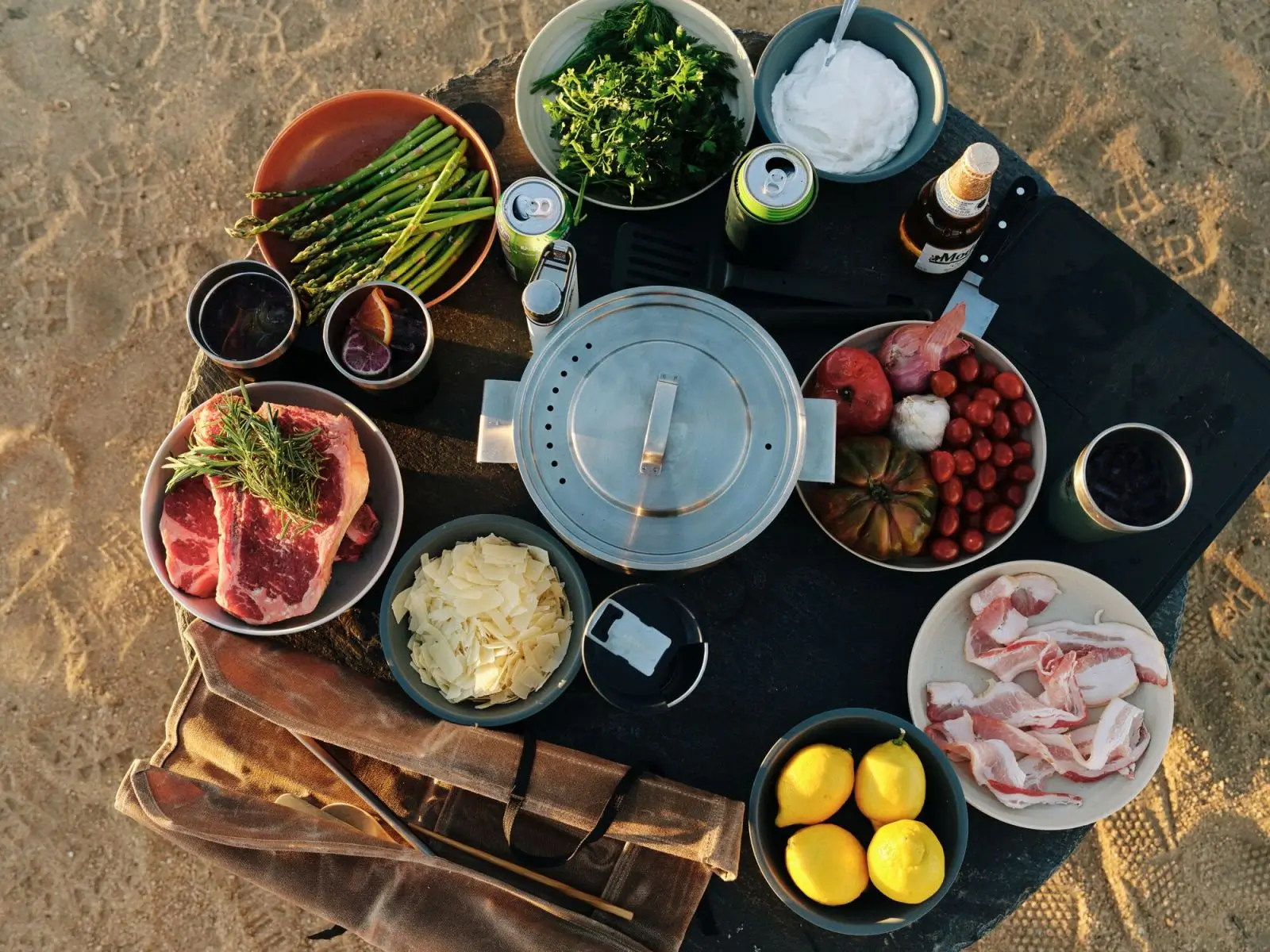
Practical advice
Do not take too much— even at a campsite, too much stuff quickly creates a mess. Less is better, but thoughtfully. Think about how to use tourist dishes, what and what can be replaced.
Choose universal solutions— a pot with a lid-pan or a set that folds "inside itself" saves space.
Select the volume for the group— guideline: ~0.7–1 l per person for cooking hot dishes. If you have doubts about the calculations, consult the store's specialistsvnedorognik.uahow not to go wrong with tourist dishes.
Check compatibility with the burner— bottom width and stability are important for quick and safe cooking.
Folding handles and covers- no small thing - it reduces the volume and makes it easier to pack dishes so that everything fits.
Do not ignore washing— a sponge, a small tool and a separate cloth significantly increase comfort. Most manufacturers give instructions on how to wash dishes when camping.
Avoid fragile materials— glass and ceramics are not for field conditions. The main mistakes when choosing dishes are improperly selected materials.
Think about heat transfer— thin metal heats up faster, but burns more easily; thick walls - more stable cooking.
Test at home— prepare food once before leaving to understand if everything is convenient.
Optimize the set for the format of the trip— trekking = minimum and weight, camping = comfort and functionality. Excess weight of equipment on a hiking trip can spoil all the impressions of the adventure.
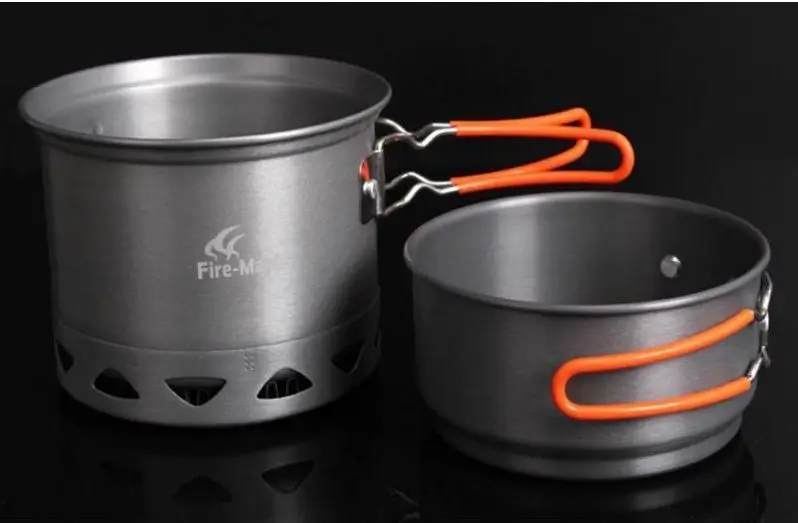
Conclusion: how to choose tourist dishes without mistakes
The right choice of travel utensils is not about "taking everything", but about a clear understanding of your travel format. In ultralight, every gram is important, in trekking - balance, in camping - comfort and functionality. It is for these tasks that you should choose a set.
There is no one-size-fits-all solution that works equally well in all scenarios. What's ideal for a mountain hike will be uncomfortable for camping, and vice versa. Therefore, the key is not in brands or materials per se, but in how well the kitchen equipment meets your conditions of use.
In short: take the minimum necessary, choose proven materials and do not complicate things. A well-thought-out set of dishes means comfort in the camp, energy saving during the trip and, as a result, more pleasure from the trip itself. Are you thinking about what to take on a camping trip? Contact usvnedorognik.ua- we will be happy to help you choose equipment for your adventures)




 4min
4min